The streetlights don't just Alight our paths anymore, they are Watching. As machine learning algorithms integrate seamlessly into our urban Jungle, our daily routines being quietly Cataloged, Categorized, and fed into endless Neural Matrix Networks.
Introduction: A New Era of Surveillance
As AI technologies and algorithms are rapidly progressing, several concerning factors regarding the use of AI for surveillance and protecting privacy arise when both are incorporated into each other. AI surveillance systems are becoming widespread around the world with facial recognition devices in cities and AI-powered Flock license plate readers on almost every block. They are creating large databases of individuals' data, building a digital footprint of them. AI can create the potential for safer societies to an extent, but we need to be careful about giving up too much power to governments and corporations to track, monitor, and can eventually be used to control are moves. I argue that AI surveillance could create issues of authoritarian control over the people if we do not create laws now that restrict government and corporations from abusing our rights. If un-safe-guarded it can be used to suppress political opposition, silence free expression, discriminate against certain groups, and or manipulate public opinion. This article is not just about AI technology, but takes a basic dive into the philosophy of surveillance, a moral questions surrounding AI surveillance, and the potential use of AI surveillance for authoritarian control if proper legislation is not put in place.
The Eyes That Never Blink: The Philosophy Behind AI Surveillance
AI surveillance makes us consider how this observation influences human behavior and who ultimately holds power in our society where nearly everything can be a data point. This opens up the philosophy around certain types of surveillance systems and how they work to change people’s actions, and who gets to decide what actions are objectively morally correct. According to Dr. Sonia Tahereh Saheb an assistant professor of Business Analytics and Information Systems at Menlo College, "In totalitarian regimes as well as democratic regimes, the vertical transmission of disparate and mass sources of urban data from citizens into one entity raises concerns about panopticism and persistent surveillance of citizens." [1]
This connects with Michel Foucault's philosophy of panopticism. Foucault used the Panopticon prison design as a metaphor for a system in which inmates never know exactly when they are being watched, forcing them to assume they are under constant surveillance. As a result, they begin to regulate their own behavior, reducing the need for guards constantly enforcing the rules.
In our day and age, this same principle can be seen through AI-powered surveillance systems. Instead of relying completely on visible displays of authority to control people, governments and institutions use surveillance technologies that are integrated into everyday life. Schools, hospitals, businesses, and workplaces all collect and monitor data in different ways. While these systems are often intended to improve security, efficiency, and accountability, they can also encourage people to change their behavior because they believe they are being watched.
This same effect can be seen through scientific research in the area of neural science as well. As Kiley Seymour a Associate Professor of Neuroscience and Behavior, explains in her research “a large body of evidence on ‘audience effects’ suggests people act in a more prosocial manner when they believe they are being watched. When people think their behavior is monitored, they are more giving more likely to share and less likely to steal, cheat, litter, or direct their gaze to provocative images.” [2]
Even if someone has done nothing wrong, knowing that their movements are being recorded will influence where they go or how they behave. In many ways, this reflects Foucault's idea that surveillance does not always need to rely on a show of force. The possibility of being watched is often enough to shape people's actions. I would argue that this is a big concern surrounding AI and surveillance. When people start changing their behavior out of fear that they are constantly being monitored, privacy becomes more than just the protection of personal information; it becomes a matter of personal freedom. A society where people feel that they are always being watched discourages free expression, limits individuality, and creates a society of self-censorship. This can affect freedom of speech and free expression and creates a society of obedient "sheeple."
This brings up an aspect of absolute morality.
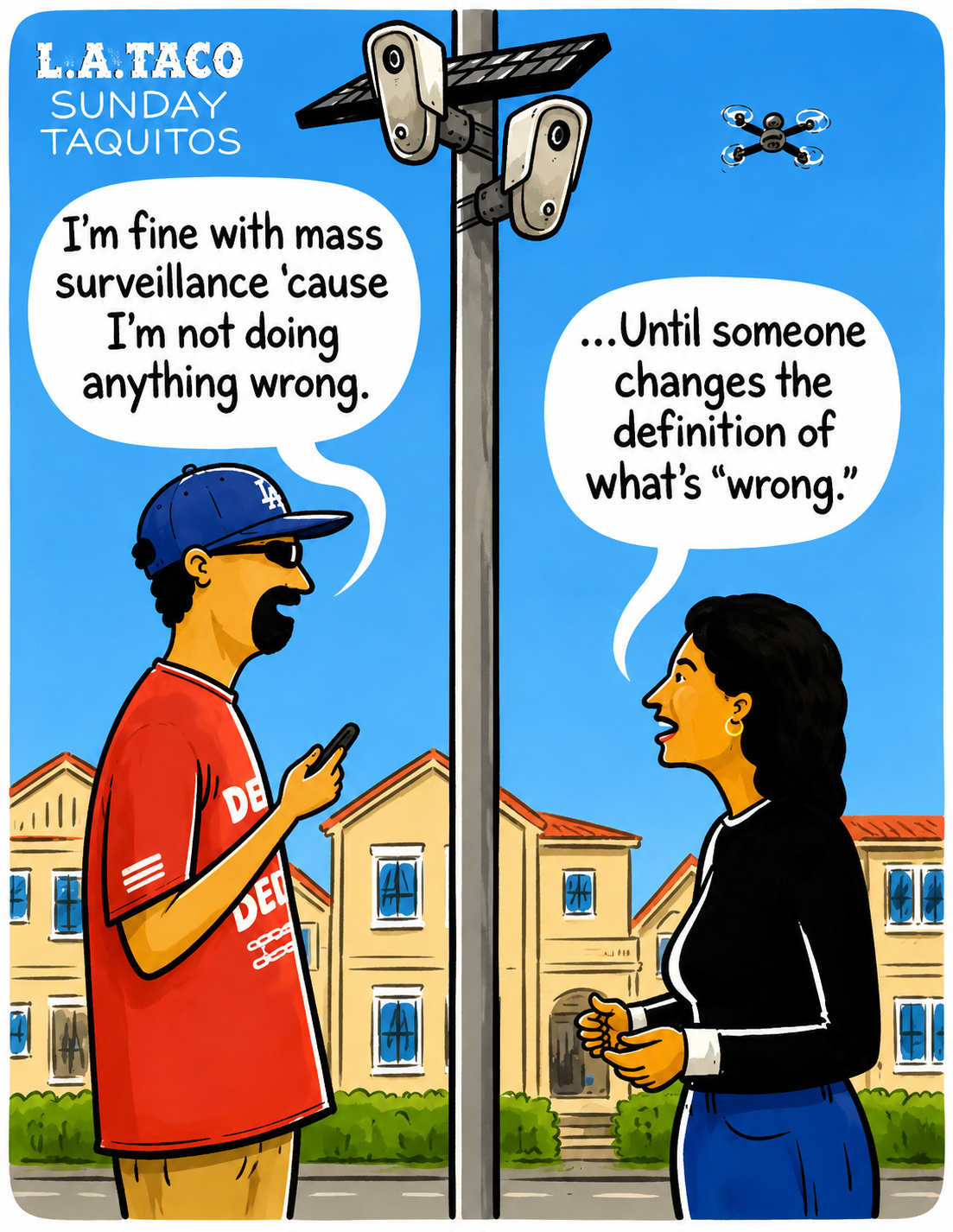
The definition of what is considered "wrong" by a surveillance system can and probably will change in the future depending on the dominant political group of the day. Throughout history, laws and social values have changed as different political groups come into power.
If you speak out about what you believe is morally "right" or have dissenting views toward a political ideology, you could be silenced or targeted if the people in power become morally degenerate or start abusing their authority. My research indicates that this is one of the biggest concerns with AI surveillance. I would argue that the AI technology itself isn't the main problem, but the amount of power it gives governments and corporations if there are not safeguards or legislation in place to prevent it from being used against the people or for political gain.
The Digital Panopticon: AI Surveillance and Authoritarian Control
Some would argue that this surveillance creates safer societies, and I would agree to an extent. As Pinghan Liang, a professor at Sun Yat-sen University in Guangzhou, China, states: "These systems preserve evidence of crime and enhance the detection of criminal activities, thereby deterring potential offenders and bolstering public perceptions of safety. Surveillance cameras have been adopted as a central element of crime prevention strategies in numerous countries, including the United States, Colombia, and China." [3]
He presents research showing that AI surveillance does increase public safety, but he does not focus his research on the use of this surveillance to suppress people in China. But, according to Cameron F. Kerry, a leader on privacy and AI at the Center of Technology Innovation (CTI), "China's use of facial recognition as a tool of authoritarian control in Xinjiang and elsewhere has awakened opposition to this expansion and calls for a ban on the use of facial recognition." [4]
With AI surveillance systems such as facial recognition devices in cities and AI-powered Flock cameras tracking and monitoring vehicles, this is creating a large database and profile of the mass public. These surveillance systems and AI technologies are converging in such a way that they can eventually be used for authoritarian control in our western societies.
One of the best examples of this is China, where AI systems enable surveillance on a massive scale. Coupled with social media monitoring, cameras, and facial recognition, this technology enables authorities to track dissidents, protesters, and government critics and identify their statements and locations to arrest or suppress their actions.
This argument is supported by Dahlia Peterson, a research analyst at Georgetown University, and Samantha Hoffman, a Senior research analyst of the Australian Strategic Policy Institute. They write:
“Some of its most severe use cases include helping to spy on political dissidents, and enabling repression of the Uyghur and Turkic Muslim populations across China. However, concerns arise even in its more “mundane” uses, which include one-to-one verification at banks and gyms. The higher quality of the data collected can help companies improve the accuracy of their facial recognition technology. Over time, these increasingly effective technologies can be used elsewhere for authoritarian purposes.” [5]
A real world example of these surveillance systems emerging is the rapidly spreading AI-powered Flock cameras in the United States and Europe, which automatically scan and record vehicle license plates, creating a database of where vehicles have traveled over time.
Several cases have opened up regarding the misuse of Flock cameras in the United States. Reporter Kristin Goodwillie from King 5 News found that Immigration and Customs Enforcement (ICE) and other federal agencies made thousands of searches on the Driver and Plate Search (DPS) databases in Washington supplied by Flock license plate readers for the purpose of tracking illegal immigrants. [6]
A few news articles have also arisen describing how law enforcement officers have used these Flock monitoring systems to track their Ex's or even their romantic interests. Although this opens up other areas of discussion and research which this article is not focusing on, these examples demonstrate that these surveillance systems can and will be misused. This will be an ever growing issue in the future that needs to be addressed now with future research, and legislation to protect our privacy and prevent abuse.
"It seems like there is a Flock camera at almost every corner in my hometown Albuquerque. Every week I notice more of them appearing, slowly becoming part of the streets. Seeing so many of them makes me question how much data is being collected about us and what end this data is being used for."
Conclusion: Safeguarding Privacy
In conclusion artificial intelligence is transforming surveillance quickly because it's algorithms analyze large amounts of data way faster than humans could. While AI surveillance can improve public safety and assist law enforcement, it will also prohibit freedom of expression and potentially be used for authoritarian control in the future. I would argue that we need to restrict and set up legislation or a national privacy bill that could help mitigate some of these issues by establishing privacy standards, protecting people from abuse, and restricting governments and corporations from putting these surveillance systems in place without proper privacy laws and accountability. As AI continues advance, protecting our individual privacy and civil rights should remain as much important as improving public safety. If we wait until these AI surveilance become deeply embedded into society before creating the proper privacy laws, it will become much harder to limit their power later. The legislation we make today about AI surveilnace systems will shape how much free exspression we will have in a society moving towards unnecessary mass surveilance. In close, this topic needs more research by scholars to bring more concerns to the general public's attention.
Works Cited
- [1]. Saheb, Tahereh. ethically Contentious Aspects of Artificial Intelligence Surveillance: A Social Science Perspective. PUBMED, 2023
- [2]. Kiley Seymour Et al. Big brother: the effects of surveillance on fundamental aspects of social vision. PUBMED, 2024.
- [3]. Pinghan Liang Et al. The heterogeneous impact of public security cameras on safety perceptions in cities: Evidence from China. PUBMED, 2025.
- [4]. Kerry, Cameron F. Protecting privacy in an AI-driven world. BROOKING, 2020.
- [5]. Dahlia Peterson and Samantha Hoffman. Research Geopolitical implications of AI and digital surveillance adoption. BROOKING, 2022.
- [6]. Kristin Goodwillie. Washington state agency under fire for sharing drivers' data with ICE. KING5, 2025.
Image Sources
Cartoon graphic used from Instagram underneath the attribution Fair Use Index
Cover Image provided by Unsplash Under the Creative Commons (CCO) license 2024.